
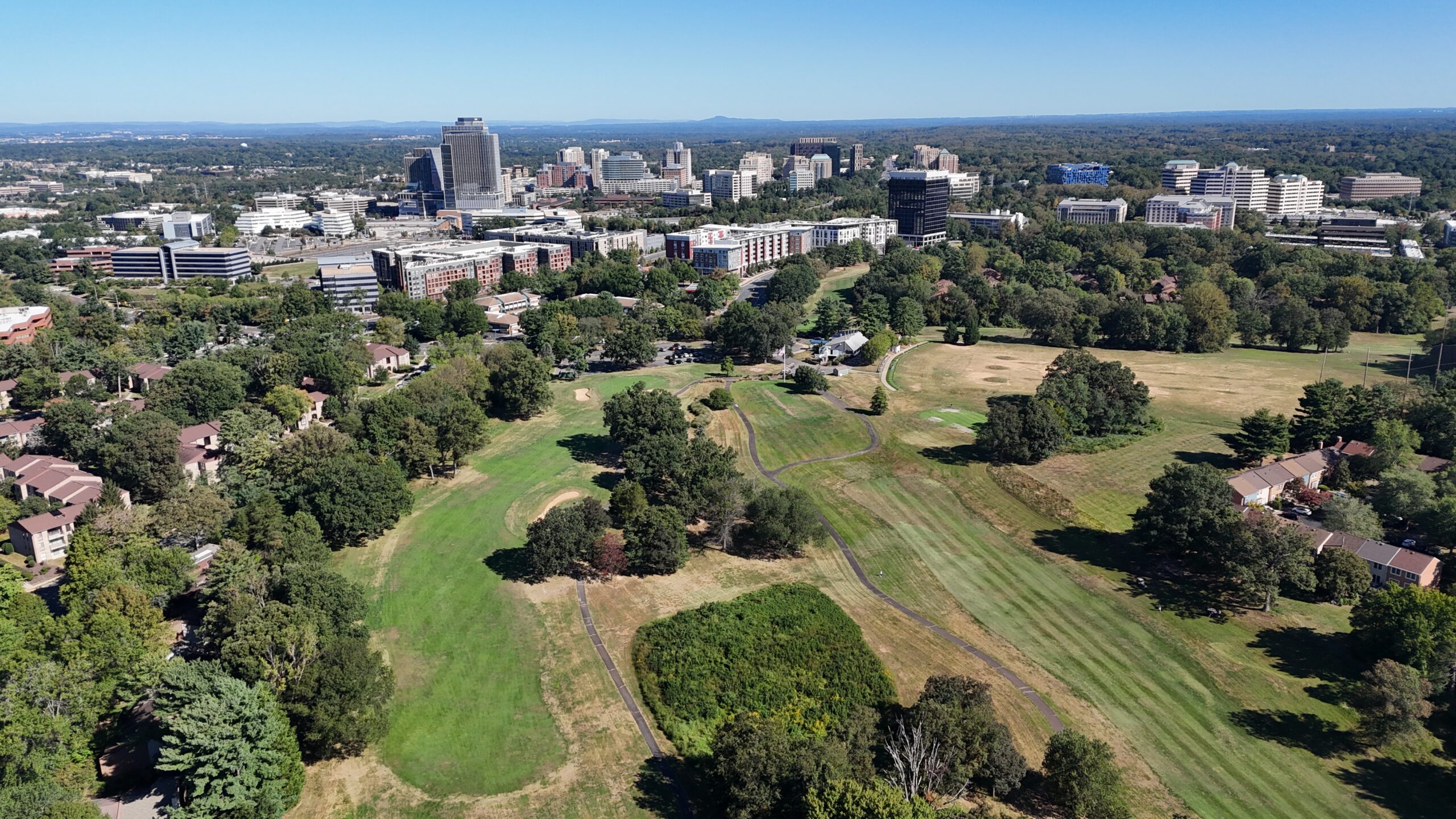
Earlier this month, detailed plans were filed with Fairfax County for 288 stacked townhomes on approximately 24.7 acres of Reston National Golf Course, coupled with extensive renovations to modernize the nearly 60-year-old golf course.
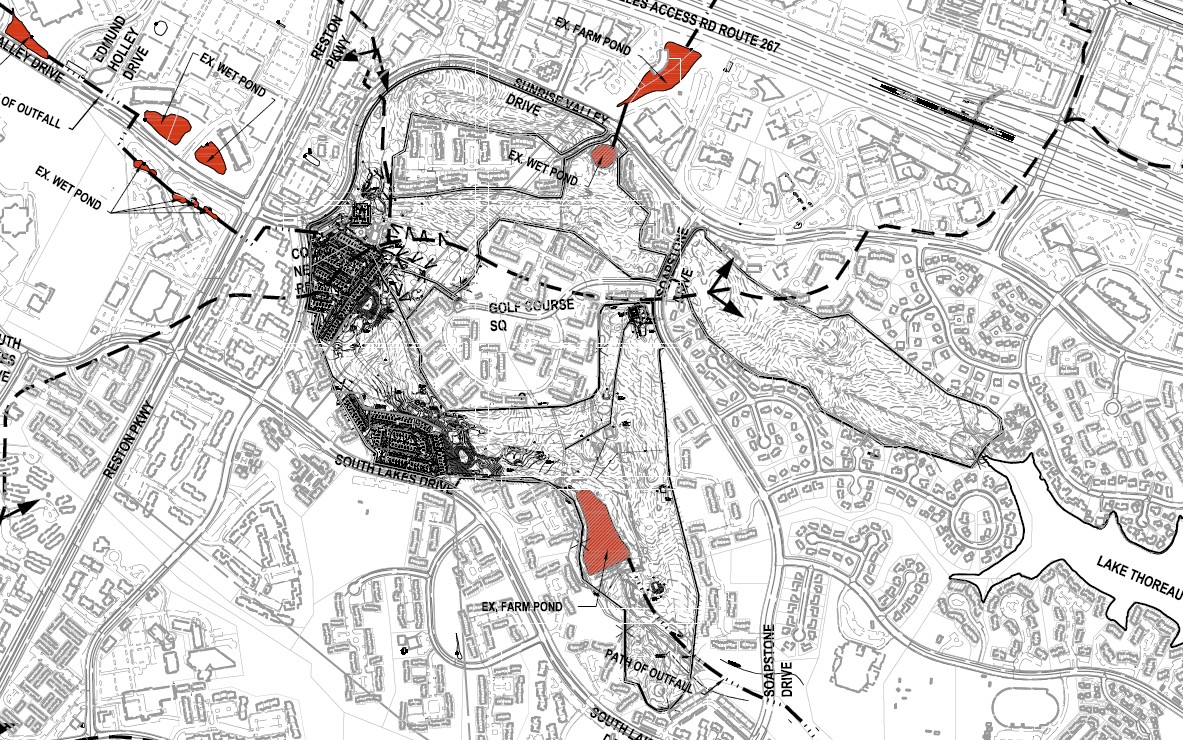
War Horse Cities, jointly with homebuilder NVR, originally filed the Statement of Justification for the updated Planned Residential Community plan amendment on September 12, 2025. The application proposes residential development on roughly 25 acres while reimagining significant portions of the 168-acre golf course with state-of-the-art facilities. This past week, details of the plans were officially submitted, reconfirming the group’s intention of pursuing approval of these amended plans under the county’s alternative review process.
The residential component would include 288 stacked townhomes in north and south residential land bays, with 17 designated affordable dwelling units. Units would be oriented to front the golf course, creating what the developer describes as an attractive view for both residents and golfers. The proposal includes five amenity areas with pedestrian walkways linking them to the golf course.
The golf course improvements outlined in the application include reconfigured holes, clubhouse updates, a new restaurant between the 12th and 13th holes, and a lighted, multi-story driving range with technology enhancements like Top Tracer and illuminated targets. The developer would also add a lighted putting course and short-game training area. War Horse Cities contends these modernizations are necessary to keep the course economically viable and competitive with other facilities in the region.
The entire proposal hinges on a dispute over zoning history. War Horse Cities claims that approximately 24.7 acres of the property were rezoned for medium-density residential uses at up to 20 dwelling units per acre back in September 1966 under RZ B-555. According to the developer, this 1966 approval permits residential development without requiring a comprehensive plan amendment. The 1971 zoning approvals that followed (RZ C-135 and RZ C-281) covered the balance of the property for golf course and open space use, but the developer argues those approvals did not amend or supersede the 1966 residential zoning on the B-555 land.
This interpretation matters enormously. If the county agrees that RZ B-555 has remained in effect since 1966 and permits the claimed density, War Horse Cities can proceed without the lengthy Site-Specific Plan Amendment process. If the county disagrees, the project faces significant hurdles.
Community advocates dispute this reading entirely. Rescue Reston has argued that the Comprehensive Plan for Reston designates golf courses for “private recreation use, more specifically to remain as golf courses,” and that there is no residential density planned for this land. The county will need to rule on whose interpretation of the 1966 zoning is correct.
The Baltimore-based developer War Horse Cities, founded by Scott Plank, brother of Under Armour founder Kevin Plank, bought the golf course in May 2019 for $23.57 million, more than four times what it sold for in 2005.
War Horse first presented this approach at a packed community meeting on April 7, 2025 at Langston Hughes Middle School, which drew an estimated 350 to 400 attendees. At that meeting, representatives outlined both a larger comprehensive plan amendment for 86.7 acres and this scaled-back plan. The larger proposal was rejected by the Fairfax County Board of Supervisors in June 2025 after the Reston Association and other community groups successfully opposed it.
The application must survive county staff review, Planning Commission scrutiny, and Board of Supervisors approval. Hunter Mill District Supervisor Walter Alcorn opposed the comprehensive plan amendment, stating he wouldn’t support changes to golf course designations unless surrounding communities wanted them. Whether he views this claim of existing residential zoning rights differently remains to be seen.
The course remains open and operating. The fight continues, now centering around the referenced 1966 zoning approval and whether it grants the developer the development rights they claim.
– Alex Dickson

