
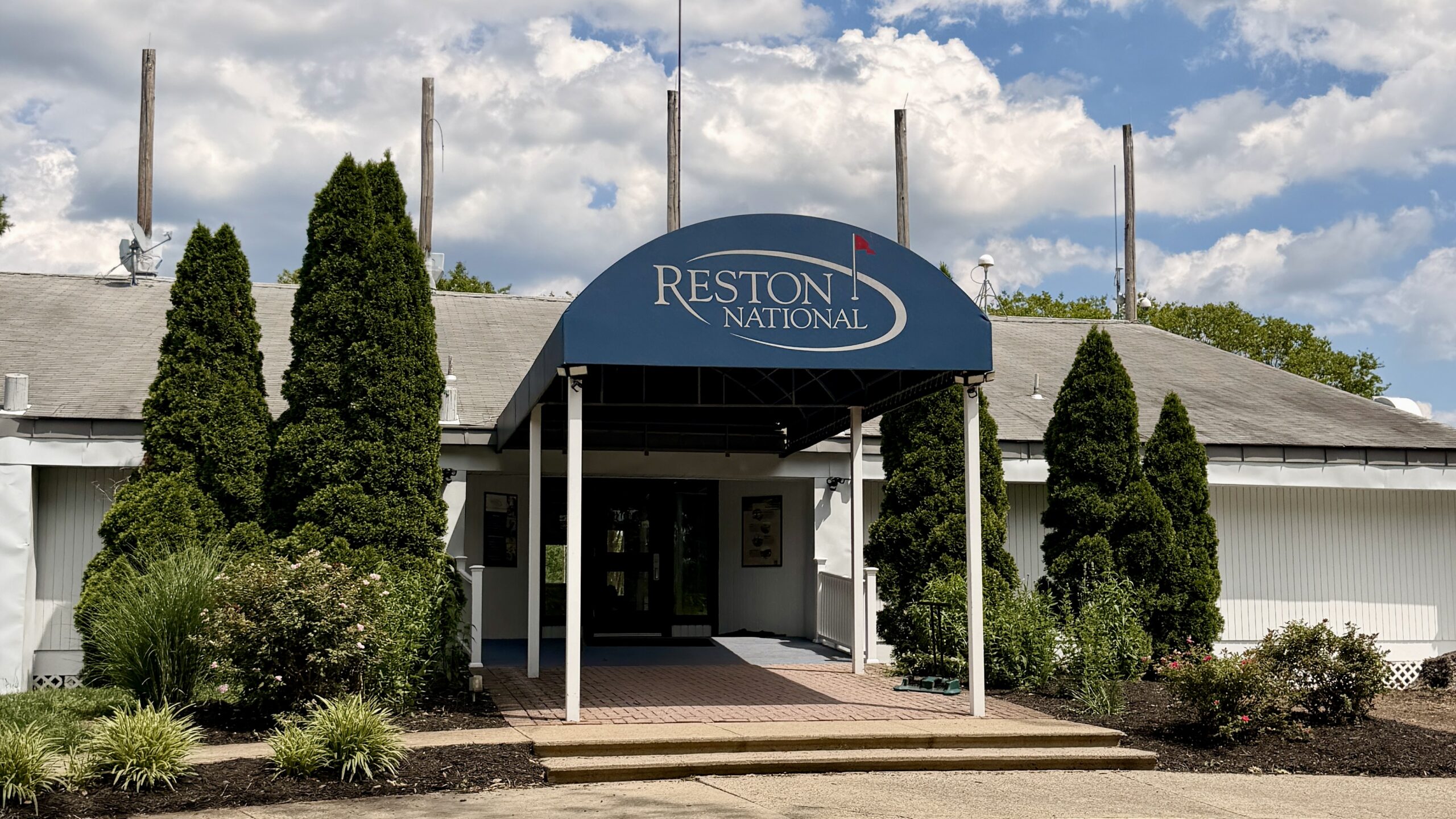
This past Friday at Reston National, the ownership group laid out their latest plans for the property and golf course. War Horse Cities, who has owned the property since 2019, was joined by course operator Kemper Sports, homebuilder NVR, and golf course architect Todd Quitno of Quitno Golf, who walked us through exactly what Reston National would look like if the county signs off. The presentation was the latest turn in this adjusted redevelopment effort we wrote about in February, when the updated plans were filed with Fairfax County.
Under the plan, the course remains 18 holes, with the nines flipped so the current back nine becomes the front. Six holes get significant changes, and the biggest of those land on the current 1st, 8th and 9th. The current 8th, which becomes the 17th once the nines flip, turns into a short par 3. To keep the course from playing too short after the reconfiguration, the plan adds a handful of new back tee boxes on existing holes, so that on paper only a few hundred yards come off the scorecard. The headline amenities are a double-decker lighted range and an expanded short-game area which could potentially include up to three short practice holes, sized in part to handle the camps and junior programs that already keep the practice end of the property busy.
The other half of the plan is the housing, where War Horse would now build 306 stacked townhomes on roughly 14 acres of the property, and the entire argument for doing it rests on a single zoning question. The owner contends that a 1966 action known as RZ B-555 already granted residential rights on that land, at up to 20 units per acre, which, in their telling, lets the housing go forward by right without a full rezoning.

Rescue Reston, the local organization that opposes any development of golf course land into housing, contends the 1966 record does not say what the owner claims. The county’s record of B-555 shows an application filed by Reston, Va., Inc., Robert Simon’s original development company, on July 20, 1966, rezoning about 134 acres from RE-2 to RPC, the designation that became today’s PRC ordinance, with the proposed use listed simply as planned community. Opponents note it makes no mention of 14 acres, twenty units per acre or any medium-density carve-out, and they argue the density the owner asserts comes from a reading of the attached development plan rather than the rezoning itself. They also point to the application’s description of the site as vacant and wooded, on a road that is now Reston Parkway and ringed by neighborhoods today, arguing the B-555 land was always meant to be part of the course. The county will have to rule on whose reading of 1966 holds up. The Reston Association, the community’s main homeowners group and a longtime opponent of course development, sent members a survey in mid June asking how much to prioritize the fight, with a board discussion set for June 25.
The next step is a public hearing in September. The PRC plan is scheduled to go before the Fairfax County Planning Commission on September 23, where the commission will take public testimony and vote on a recommendation. That recommendation then heads to the Board of Supervisors, which holds the final say. It is also the first stage at which the county takes a public position on the 1966 rights claim rather than reviewing it at the staff level.
This is not the first redevelopment plan this ownership group has put forward. Earlier proposals, including a 2025 comprehensive plan amendment that would have opened up 86.7 acres, sought to convert the bulk of the site to housing and would have eliminated the golf course. The current plan retains all 18 holes. War Horse bought Reston National in 2019 for $23.57 million, a price county records noted as reflecting future redevelopment.
For golfers, the clear win in this plan is that Reston National would remain an 18-hole golf course. What is far less clear is what kind of 18 holes it becomes. Whether the reconfigured holes and the new back tees added to recover the lost yardage make the course better, worse, or simply a layout awkwardly jammed into the acreage that is left is a question the plans on paper cannot answer. That verdict would have to wait until the redesign is approved, built and played.
Additional photos and information on the Reston National GC website.
– Alex Dickson


